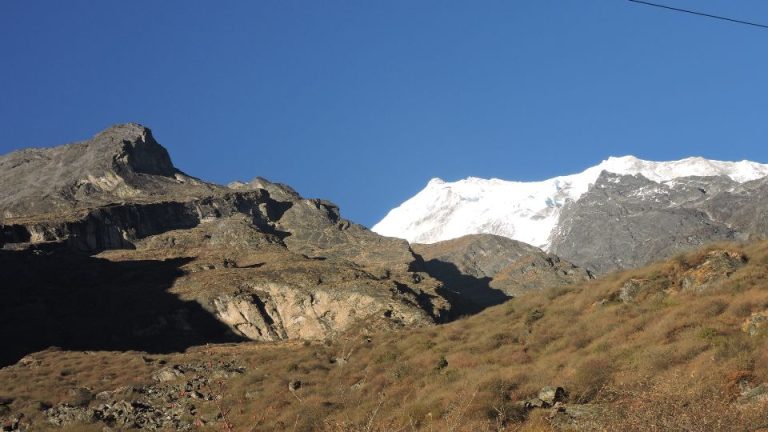
Monastery of Kyanjin Gompa: History, Architecture, Culture
Introduction to the Kyanjin Gompa (Monastery)
Historically, ‘Kyanjin Gompa’ referred exclusively to the monastery itself (‘Gompa’ translates to ‘monastery’ in Tibetan and local dialects). However, as international trekking expanded, early visitors began applying the sacred site’s name to the entire Village. To ensure clarity for readers in this article, ‘Kyanjin Gompa‘ denotes the broader village, while ‘Kyanjin Gompa (Monastery)’ specifically identifies the historic Buddhist structure inside the village.
The Kyanjin Gompa (Monastery) is not merely a religious edifice; it functions as the central nervous system of the Langtang valley’s cultural identity. For the local Lama and Tamang populations, whose linguistic and ethnic roots trace directly back to the Tibetan plateau, the monastery is the anchor of their religious understanding. It regulates the spiritual calendar, sanctifies the landscape, and provides a spatial mechanism for the community to interface with the divine. The Tamang people, who have inhabited the Langtang Valley for centuries, regard the Gompa as an artistic and spiritual hub that binds their community together and maintains their connection to their ancestral heritage.
This article describes the various aspects of Kyanjin Gompa (Monastery). By delineating its historical establishment, architectural morphology, sacred contents, and precise ritualistic frameworks, a nuanced portrait emerges of a religious center that has survived the absolute extremes of both geographical isolation and catastrophic seismic upheaval. The survival and reconstruction of Kyanjin Gompa (Monastery) offer a masterclass in Himalayan adaptability, demonstrating how ancient sectarian lineages can integrate with modern architectural engineering to preserve the spiritual heartbeat of an indigenous population.
Table of Contents
Historical Timeline and Lineage Establishment
Origins, Etymology, and the Century of Construction
The precise historical timeline of Kyanjin Gompa (Monastery) is characterized by a complex interplay of local folklore, oral histories preserved by indigenous stewards, and the physical dating of its internal artifacts. The toponym “Kyanjin” is derived from local mythos, translating roughly from regional Tibetan dialects as “camel ribs,” referencing a prominent, naturally occurring rock formation upon which the original foundational structures of the monastery were purportedly laid (“Kyan” denoting camel, and “jin” denoting ribs). The community that historically stewarded the monastery is the Dhomare clan, a demographic group whose name translates to “the inhabitants of the land of red rocks,” reflecting the iron-rich geology of their ancestral terrain. This clan traces its lineage directly back to migratory groups that crossed the Himalayan passes from Tibet to settle in the more temperate, yet still formidable, high valleys of northern Nepal.
Determining the exact century of construction requires reconciling varying historical accounts. Oral traditions maintained by the Dhomare clan’s historical head, Thiley Lama, suggest that the spiritual occupation of the site and the earliest structural iterations may stretch back nearly six centuries. However, architectural and anthropological consensus, combined with the material analysis of the structure, estimates the physical construction of the primary Gompa building as it is recognized today to have occurred approximately 300 to 400 years ago, placing its institutional origins in the 17th or early 18th century. This timeline is heavily corroborated by the presence of highly specific sacred artifacts within the monastery. Most notably, the original Thangka paintings and frescoes adorning the inner sanctum were brought across the Himalayas from Tibet approximately 400 years ago. Therefore, while the spiritual consecration of the geographic site may predate the current era, the institutional and structural establishment of Kyanjin Gompa (Monastery) firmly belongs to a 400-year historical paradigm, establishing it as the oldest functioning monastery in the Langtang region.
Sectarian Affiliation: The Nyingma Tradition
Kyanjin Gompa (Monastery) is strictly affiliated with the Nyingma school of Tibetan Buddhism, widely recognized as the “Ancient” or Red Hat sect. The Nyingma tradition holds a unique position within the broader tapestry of Himalayan religions, as it is the oldest of the four major schools of Tibetan Buddhism, tracing its origins directly to the eighth-century arrival of the tantric master Padmasambhava, universally revered in the Himalayas as Guru Rinpoche.
The theological underpinnings of the Nyingma school are highly distinct. Unlike the later Sarma (New Translation) schools such as the Gelug, Kagyu, and Sakya, which emphasize highly institutionalized monastic debate and strict celibacy, the Nyingma tradition places a profound emphasis on esoteric tantric practices, the pursuit of Dzogchen (the “Great Perfection”), and the revelation of terma (hidden treasure texts). According to Nyingma history, Guru Rinpoche (Padmasambhava) was instrumental in subduing the indigenous, often hostile animistic spirits of the high mountains, converting them into Dharmapalas (protectors of the Buddhist teachings).
The establishment of Kyanjin Gompa (Monastery) in such a remote, inhospitable glacial valley aligns perfectly with the Nyingma tradition of seeking out highly isolated, spiritually charged environments for intensive meditation and esoteric tantric practice. The lineage practiced at Kyanjin Gompa (Monastery) reflects this ancient heritage, focusing heavily on direct transmission from master to disciple, the integration of lay practitioners (Ngagpas) with ordained monastics, and a profound reverence for the natural landscape as an emanation of the divine. The very geography of the Langtang Valley, with its towering peaks and sweeping glaciers, is not viewed merely as physical terrain, but as a sacred mandala inhabited by localized deities that have been bound by oath to protect the Dharma.
The 2015 Earthquake: Catastrophic Structural Impact
The historical trajectory of Kyanjin Gompa (Monastery) was violently interrupted on the morning of April 25, 2015, when a massive magnitude 7.8 earthquake struck Nepal, including the whole Lantang Valley. The seismic event triggered an unprecedented catastrophe in the Langtang Valley, radically altering both its topography and its demographic makeup. The earthquake caused a massive section of the Langtang Lirung glacier to fracture and shear away from the mountainside. The resulting avalanche brought an estimated 40 million tons of rock, glacial ice, and debris crashing down into the valley floor, generating an atmospheric pressure wave carrying half the explosive force of a modern atomic bomb. The original Langtang village, located slightly lower in the valley than Kyanjin Gompa, was entirely obliterated, resulting in the deaths of over 300 local residents and foreign trekkers, leaving only a single structure sheltered under an overhang.
While Kyanjin Gompa (Monastery) was situated at a higher elevation and largely escaped the direct, obliterating impact of the primary avalanche, the settlement and the monastery sustained catastrophic structural damage due to the intense ground acceleration and subsequent powerful aftershocks, including a severe magnitude 7.3 event on May 12, 2015. The ancient load-bearing stone walls of the Gompa suffered severe shear cracking, the roof structures were compromised, and numerous adjacent stupas and residential quarters were leveled. The structural failure of the monastery represented not just a loss of physical infrastructure, but a profound psychological blow to a community dealing with immense trauma, mass fatalities, and the total disruption of their pastoral and tourism-based economy.
Timeline of Reconstruction and Global Funding Paradigms
The timeline of rebuilding Kyanjin Gompa (Monastery) and the surrounding infrastructure highlights a remarkable synthesis of local resilience and highly specialized international intervention. In the immediate aftermath, survival and temporary shelter took absolute precedence, with the Langtang Relief Fund and the Nepalese Armed Forces coordinating emergency evacuations and the distribution of basic supplies. It was not until late 2015 and early 2016, following the establishment of the National Reconstruction Authority (NRA) by the Nepalese government, that systemic reconstruction efforts for the monastery commenced.
The funding and technical execution of the Gompa’s restoration relied heavily on international cooperation, most notably from the Japanese government and related bilateral aid organizations. Japan, possessing parallel geographical challenges regarding frequent high-magnitude seismic events and the preservation of historic timber-and-masonry structures, provided both substantial financial capital and specialized architectural expertise. Japanese structural engineers, operating under the “Build Back Better” (BBB) initiative promoted by the Japan International Cooperation Agency (JICA) and the Department of Archaeology (DOA) of Nepal, introduced modern seismic retrofitting techniques to the ancient structures.
| Reconstruction Phase | Chronological Timeline | Primary Actors and Funding Sources |
| Emergency Evacuation and Assessment | April 2015 – August 2015 | Local survivors, Nepalese Armed Forces, Langtang Relief Fund. |
| Needs Assessment & Global Funding Alignment | Late 2015 | National Reconstruction Authority (NRA), Asian Development Bank, Sunaulo Sansar (mobilizing Swiss and German funds). |
| Architectural Retrofitting and Construction | 2016 – 2018 | Japanese Government (JICA), Nepalese DOA, Himalayan Climate Initiative, local Tamang laborers. |
| Spiritual Reconsecration | 2018 – Present | Local Dhomare clan, Tamang community leaders, visiting Rinpoches and Ngagpas. |
The reconstruction deliberately integrated modern, earthquake-resistant design philosophies such as reinforced concrete foundations and concealed timber ring-beams while meticulously preserving the historic aesthetic of the monastery. European non-governmental organizations, such as Sunaulo Sansar, mobilized funds and volunteer labor from Switzerland and Germany to assist in the broader village reconstruction. This international synergy, bolstered by the sheer determination of the surviving local population, allowed Kyanjin Gompa (Monastery) to be entirely rebuilt and reconsecrated, standing today as a monument to post-disaster recovery and an anchor for the region’s revitalized sustainable tourism.
Architecture of the Kyanjin Gompa Monastery
The architectural design of Kyanjin Gompa (Monastery) is a testament to the adaptive engineering of Himalayan builders. The structure is designed to withstand extreme thermal fluctuations, high wind loads, and tectonic instability, all while adhering to the strict spatial, acoustic, and geometric requirements of Tibetan Buddhist cosmology. The layout is highly intentional, functioning as a three-dimensional mandala that guides the practitioner from the profane exterior world into the sacred interior sanctum.
Exterior Construction: Materials and Form
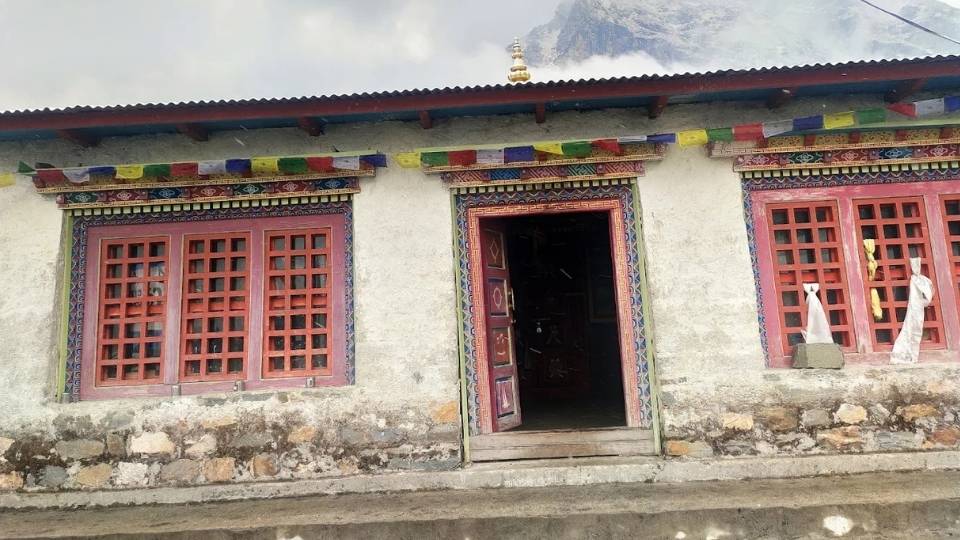
The exterior of the monastery is defined by its rugged, pragmatic integration with the harsh alpine environment. The primary load-bearing walls are constructed from locally quarried stone, gathered directly from the surrounding glacial moraines and mountain slopes. These irregular stones are traditionally dry-fitted or bound with a localized mud mortar, a technique that historically provided slight flexibility during minor tremors. Following the catastrophic failure of similar masonry during the 2015 earthquake, the reconstructed stone facades were reinforced with modern engineering techniques, yet they maintain their traditional, thick profile. The exterior walls are heavily white-washed, a symbolic representation of spiritual purity that provides a stark, luminous contrast to the dark, rocky terrain and the deep blue of the high-altitude sky.
Carved timber plays a vital structural and aesthetic role within this masonry shell. Heavy wooden beams, sourced from the lower, temperate rhododendron and pine forests of the Langtang National Park, form the internal skeleton of the building, supporting the roof and framing the doorways. These timbers are intricately carved by specialized artisans with traditional Tibetan motifs, including endless knots, lotus patterns, and snow lions, serving both to distribute the weight of the roof and to beautify the sacred space.
Historically, the roof of such a structure would have been constructed of heavy slate tiles or wooden shingles. However, modern adaptations, particularly in the post-earthquake era where minimizing structural dead-load is critical for seismic resilience, have seen the universal introduction of corrugated iron roofing. This material, often painted red or green to mimic the aesthetic of traditional monastic roofs across Tibet and Nepal, drastically reduces the weight pressing down on the stone walls, thereby significantly improving the building’s overall seismic performance.
Mani Korlo and Exterior Sanctification
The perimeter of the Gompa is heavily circumscribed by complex arrays of Mani Korlo (prayer wheels) embedded within the outer walls, alongside extensive free-standing Mani walls. These architectural features are not merely decorative; they act as active spiritual machinery that interfaces constantly with the environment.
The prayer wheels are heavy, cylindrical barrels, usually constructed of embossed copper or brass, mounted on a central spindle. Inside each sealed cylinder are tightly rolled scrolls bearing thousands, sometimes millions, of repetitions of the six-syllable Avalokiteshvara mantra: Om Mani Padme Hum. According to Vajrayana mechanics, the physical spinning of the wheel generates kinetic energy that radiates the intention of the mantras outward into the valley, functioning identically to the vocal recitation of the text, but at an exponentially higher volume and efficiency.
The adjacent Mani walls are constructed from thousands of individually carved stone tablets, each bearing the same sacred syllables or longer sutras. These elements effectively sanctify the exterior environment, creating a boundary of highly charged spiritual energy. The presence of these walls creates a distinct phenomenological boundary, imbuing the area with a positive energy that prepares the practitioner for entry into the inner sanctum and encourages states of meditation and tranquility.
The Main Prayer Hall (Dukhang)
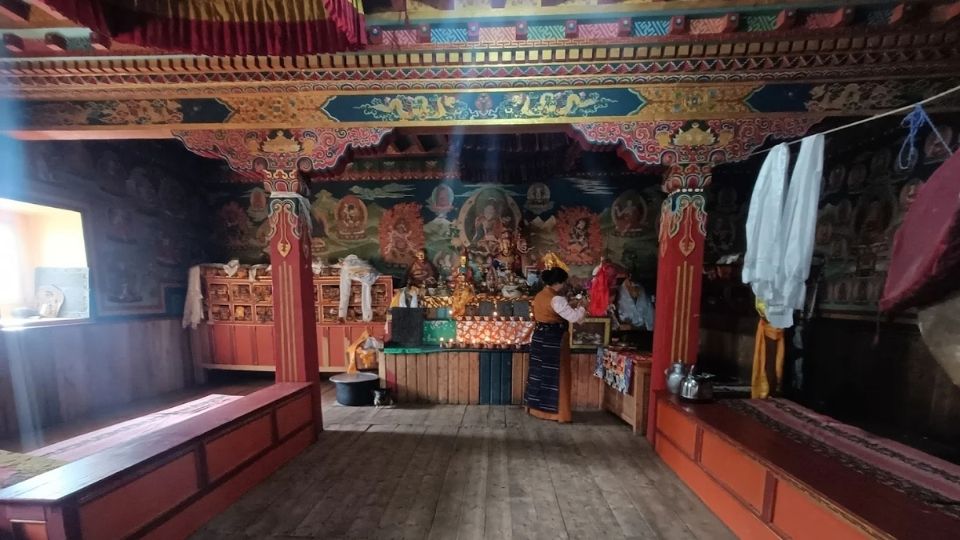
The interior spatial organization is centered entirely around the Dukhang, the main assembly and prayer hall. The Dukhang serves a dual function: it is the communal gathering space for the laity during major festivals and the primary theater for esoteric monastic ritual. Architecturally, the hall is designed on a longitudinal axis, drawing the eye inexorably forward toward the main altar at the far end.
The spatial dynamics are characterized by an interplay of shadow and light. The space is deliberately dim, illuminated primarily by natural light filtering through the main doors and the warm, flickering glow of hundreds of butter lamps lining the altar. This lighting is phenomenologically intentional, designed to detach the practitioner from the mundane external world and induce a state of contemplative receptivity. The physical layout consists of low, cushioned wooden benches running parallel to the central aisle, where practitioners and visiting monastics sit facing one another. This parallel seating arrangement ensures that during communal chanting, the acoustic resonance of the prayers and instruments is concentrated and amplified within the center of the room, creating an immersive auditory environment.
Murals and Iconography
The interior walls of the Dukhang are adorned with elaborate frescoes and Thangka paintings, some of which are documented to be over 400 years old, having been brought from Tibet during the original establishment of the Gompa. These murals are not merely decorative art; they are strictly governed by traditional Tibetan iconographic proportions (Iconometry) and serve as complex visual encyclopedias of Buddhist philosophy, outlining the path to enlightenment.
| Iconographic Subject | Location / Form | Philosophical and Spiritual Function |
| The Wheel of Life (Bhavachakra) | Foyer or rear walls of the Dukhang. | Illustrates the concept of pratityasamutpada (dependent origination). Held by Yama (Lord of Death), it depicts the six realms of Samsara, driven by the three poisons: ignorance (pig), attachment (rooster), and aversion (snake). |
| Protective Deities (Dharmapalas) | Flanking the entrance and main assembly areas. | Depicted in wrathful forms, wreathed in flames, stepping on corpses representing the ego. Their function is to terrify and subjugate internal psychological obstacles and external demonic forces hindering enlightenment. |
| Lineage of Lamas | Side walls, progressing toward the altar. | Chronicles the historical transmission of Dzogchen teachings, tracing the unbroken lineage from primordial Buddhas down through Padmasambhava to the local human stewards of the Dhomare clan, authenticating the site’s authority. |
These murals transform the Dukhang into an educational and meditative tool, where highly complex theological concepts—ranging from the inevitability of death to the mechanics of karma—are rendered in vivid, terrifying, and beautiful detail.
Sacred Artifacts and Relics
The spiritual authority of Kyanjin Gompa (Monastery) is fundamentally anchored by its repository of sacred objects. Within the framework of Tibetan Buddhism, these artifacts are not viewed by practitioners as mere symbolic representations. Through the complex ritual process of consecration—which involves placing mantras and relics inside the object to invite the actual presence of the deity—they are treated as living, breathing embodiments of divine forces.
Central Statues of the Altar
The focal point of the Dukhang is the elevated main altar, which houses an array of highly venerated figures crafted from clay, wood, and metal. The theological hierarchy of these statues directly reflects the specific philosophical orientation of the Nyingma tradition.
- Guru Rinpoche (Padmasambhava): As the founder of the Nyingma school and the “second Buddha” of the Himalayas, Guru Rinpoche occupies a position of supreme importance. A significant, finely crafted metal statue of Padmasambhava was added to the altar relatively recently, prior to the major earthquake. Iconographically, he is depicted in his traditional form, wearing three monastic robes to signify his mastery of the different vehicles of Buddhism. In his hands, he holds a vajra (thunderbolt), representing indestructible, compassionate action, and a skull-cup containing the nectar of immortality, symbolizing profound, non-dual wisdom.
- Sakyamuni Buddha and Chenrezig: Alongside the tantric founder sits Gautama Buddha (Sakyamuni), the historical Buddha, representing the foundational sutra teachings and the path of renunciation. Accompanying him is Chenrezig (Avalokiteshvara), the Bodhisattva of absolute, boundless compassion and the patron deity of Tibet. Together, these figures balance the highly esoteric, magical tantric practices of the Nyingma school with the universal Mahayana ethics of altruism.
- The 13 Dhomare Ancestors: A feature highly unique to Kyanjin Gompa (Monastery) are 13 ancient clay statues representing the genealogical ancestors of the local Dhomare clan. These figures highlight the deeply localized, syncretic nature of Himalayan Buddhism, where high monastic philosophy seamlessly integrates with indigenous animism and ancestor veneration. They serve as a permanent reminder of the specific human lineage that has guarded the valley.
- The Mythical Frog Stone: Resting prominently in the center of the monastery is a large, uncarved stone that locals believe structurally resembles a frog. According to deep local mythos, this stone has remained in place since the exact moment of the Gompa’s foundation. In Himalayan folklore, frogs are often associated with subterranean water spirits (Nagas) and the pacification of the earth. This stone represents the subjugated terrestrial spirits of the land upon which the Buddhist structure was built.
Ritual Objects in Daily Practice
The sensory environment of the daily liturgy is orchestrated through specific, highly specialized ritual implements crafted by traditional metalworkers (Tamrakars) and sculptors. The altar is lined with traditional copper butter lamps. In the high-altitude pastoral economy of Langtang, yak butter is a precious, calorie-dense commodity. Burning it as fuel for these lamps symbolizes the sacrifice of material wealth to produce the light of wisdom, theoretically dispelling the darkness of spiritual ignorance (avidya).
Before the statues rest sets of Ting—small copper or silver offering bowls. These are filled daily with pure glacial water, representing the seven traditional offerings made to a revered guest (water for drinking, washing, flowers, incense, light, perfume, and food).
The acoustic environment of the rituals, vital for inducing meditative trance states, is driven by large brass cymbals and the Radong (the traditional Tibetan long horns). The cymbals dictate the complex rhythm of the chanting, while the deep, guttural resonance of the Radong is designed to mimic the primordial sounds of elephants and rolling thunder. This overwhelming acoustic frequency is intentionally designed to shatter ordinary conceptual thought and establish an auditory landscape conducive to advanced tantric visualization.
Sacred Texts: The Kangyur and Tengyur
Housed within intricately carved wooden shelving along the peripheral walls of the Dukhang are the Pechas—traditional, unbound Tibetan books. These texts consist of long, rectangular pages wrapped in heavy silk cloth and compressed tightly between wooden boards. These extensive libraries comprise the Kangyur (the direct, translated words of the historical Buddha) and the Tengyur (the massive collection of translated commentaries by subsequent Indian and Tibetan scholastic masters).
In the Nyingma tradition, the physical text is treated with the exact same reverence as a statue of the Buddha, representing the Dharmakaya (the body of ultimate truth). Practitioners are strictly forbidden from placing these texts on the floor, stepping over them, or treating them casually. The preservation of these Pechas in a climate characterized by extreme humidity variations and freezing winter temperatures is a constant physical struggle, relying heavily on the insulating properties of the timber architecture and the devotion of the local caretakers to prevent rot and degradation.
Monastic Life and Ritual Schedules
The demographic and administrative structure of Kyanjin Gompa (Monastery) presents a fascinating anomaly within the broader context of Himalayan monasticism. Following the devastation of the earthquake and broader socioeconomic shifts in the region, including the rise of the trekking industry, the traditional mechanics of monastic life have evolved into a highly communal, decentralized model.
Resident Hierarchy: The Empty Gompa
Unlike large institutional monasteries in Kathmandu or Lhasa, Kyanjin Gompa (Monastery) does not currently house a large, permanent population of resident, celibate monks. Instead, the facility relies on a system of community-driven stewardship. The villagers of Kyanjin, primarily belonging to the Tamang ethnic group and the historic Dhomare clan, take rotational turns holding the keys, opening the temple, and maintaining the daily upkeep.
Spiritual authority and high-level ritual management are overseen by a designated head Lama—historically figures like Thiley Lama, who carries the oral traditions and manages the esoteric requirements of the lineage. When major rituals or specific lifecycle ceremonies (such as funerals) are required, monks and Ngagpas (non-celibate tantric practitioners common in the Nyingma school) from the surrounding Helambu and Langtang regions congregate at the Gompa, temporarily filling the void.
This creates a unique atmosphere; on an average day, the Gompa may feel architecturally deserted, functioning primarily as a quiet hermitage for trekkers and locals seeking solace, only to explode into intense acoustic and visual activity during scheduled liturgical events. Furthermore, directly behind the monastery operates a home for the elderly, housing individuals who lost their families during the 2015 earthquake. The villagers take communal responsibility for caring for these elders, closely tying the religious function of the Gompa to tangible social welfare.
Daily Puja and the Mechanics of Worship
Despite the lack of permanent residents, the fundamental daily rituals (Pujas) are meticulously maintained by the designated caretakers and visiting monastics. The daily schedule is dictated by the rising and setting of the sun, reflecting a deep integration with the natural rhythms of the high-altitude environment.
The morning Puja begins with the physical purification of the space: sweeping the Dukhang, replacing the water in the Ting offering bowls, and trimming the wicks to light the copper butter lamps. A critical olfactory component of the daily ritual is the burning of Sang—dried juniper branches mixed with specialized incense powder, burned in large stone urns outside the Gompa. The thick, fragrant smoke of the juniper is believed to purify both the physical and spiritual environment, carrying the offerings and intentions of the practitioners directly upward to the mountain deities and the Buddhas. The chanting ceremonies involve the recitation of specific sutras—often focusing on the life of the Buddha and the invocations of Guru Rinpoche—utilizing the rhythmic striking of cymbals and the spinning of prayer beads to pace the complex, polyphonic throat singing.
Local Festivals and Regional Commemorations
The liturgical calendar of Kyanjin Gompa (Monastery) is punctuated by major regional events that synchronize the community with the lunar cycles of the Tibetan calendar. During these periods, the monastery reclaims its status as the absolute center of life in the Langtang Valley.
| Festival | Timing (Lunar Calendar) | Ritual Significance and Community Activities |
| Lhosar | First Lunar Month (Feb/March) | The Tibetan New Year. This is the most significant event at Kyanjin Gompa. It involves mass community gatherings, extensive feasting, the renewal of prayer flags across the valley, and intense Pujas to clear the karmic debts of the previous year. |
| Monlam | Days 4-11 of the First Month | The Great Prayer Festival, following closely after Lhosar. Dedicated to world peace and the flourishing of the Dharma. Characterized by intensive, multi-day chanting and communal merit-making. |
| Buddha Jayanti (Saga Dawa) | Fourth Lunar Month (May) | Commemorates the birth, enlightenment, and passing (Mahaparinirvana) of Sakyamuni Buddha. Monks lead special Pujas, recite the Sutra of the Buddha’s life, and light hundreds of butter lamps. |
During these festivals, local villagers, trans-Himalayan pilgrims, and trekkers converge. Locals share vegetarian meals, while children receive oral histories and teachings from the elders, ensuring the intergenerational transmission of the Tamang-Buddhist heritage.
Visitor Protocol and Etiquette
The integration of Kyanjin Gompa (Monastery) into the international Langtang Valley trekking circuit requires a delicate, highly negotiated balance between welcoming global tourism (which has become economically vital in the post-earthquake era) and maintaining the strict sanctity of a functioning Vajrayana ritual space. The spiritual efficacy of the Gompa relies on purity, and specific protocols are enforced to ensure visitors do not disrupt the cosmological order.
Circumambulation (Kora)
The primary physical interaction a visitor will have with the Gompa and its immediate surroundings is the practice of Kora, or circumambulation. It is a strict, non-negotiable rule that all movement around the exterior of the monastery, the stupas, and the Mani walls must be executed in a clockwise direction.
This rule is deeply rooted in ancient Indo-Tibetan cosmology, where moving clockwise mimics the path of the sun across the sky, aligning the physical body of the practitioner with the natural, harmonious progression of the universe. Walking counter-clockwise is associated with the pre-Buddhist Bon religion and is considered highly disrespectful or actively disruptive to the generated energy of the Buddhist space. While walking, visitors are highly encouraged to interact with the exterior prayer wheels, but they must ensure the wheels rotate clockwise, effectively “reading” the internal mantra scrolls in the correct temporal sequence.
Interior Rules and Spatial Respect
Upon crossing the threshold into the Dukhang, the visitor transitions from the mundane physical world into a consecrated mandala. Strict interior rules apply to enforce humility and minimize energetic pollution:
- Removing Footwear: Shoes must absolutely be removed before entering the main prayer hall. This is a fundamental Asian sign of respect, preventing the physical filth of the outside world from defiling the space where the Dharma is taught and practiced.
- Modesty in Dress: Visitors must dress appropriately, ensuring that shoulders and knees are covered. The exposure of excessive skin is considered a distraction from the ascetic ideals of the monastic environment.
- Prohibition of Flash Photography: While the murals and statues are visually stunning, they are not museum exhibits. Taking photographs, particularly with a flash, is strictly prohibited unless explicit permission is granted by the attending caretaker or head Lama. The intrusive nature of modern flash photography is viewed as disruptive to meditation, disrespectful to the residing deities, and chemically damaging to the ancient mineral pigments of the Thangkas.
- Acoustic Discipline: Absolute silence or hushed whispering is expected. Visitors must not touch the ritual objects, texts, or statues, and must maintain a respectful physical distance from any monks or locals engaged in active prayer.
The Practice of Dana (Monetary Offerings)
It is standard, highly encouraged practice for visitors to leave a monetary offering, known as Dana, when visiting the Gompa. Dana is a fundamental Buddhist virtue translating directly to generosity or giving. In the context of Kyanjin Gompa, leaving small denominations of Nepalese Rupees on the altar or in designated donation boxes serves two critical, interconnected functions.
Economically, it provides the essential capital required to purchase butter for the lamps, repair structural wear from the harsh winters, and fundamentally support the elderly survivors of the 2015 earthquake who reside in the care facility directly behind the monastery. Spiritually, the act of giving allows the visitor to bypass their own material attachments and cultivate positive karma, directly participating in the merit generated by the ongoing rituals of the institution. Through Dana, the tourist transitions from a passive observer into an active participant in the survival and flourishing of the Gompa.
Conclusion
Kyanjin Gompa Monastery stands as a profound architectural and spiritual achievement, clinging to the edge of habitability in the high Himalayas. Its lineage, deeply rooted in the 400-year-old traditions of the Nyingma school and the stewardship of the Dhomare clan, has survived geographic isolation, the harsh realities of high-altitude pastoralism, and the catastrophic, valley-altering devastation of the 2015 earthquake. The successful reconstruction of the Gompa—facilitated by a remarkable synthesis of international engineering expertise from Japan, European funding, and fierce local resilience—highlights its indispensable role as the cultural nexus of the Langtang Valley.
Through its meticulous preservation of ancient Thangkas, its rigid adherence to the rituals of Guru Rinpoche, and its daily rhythms of juniper smoke and chanted mantras, Kyanjin Gompa (Monastery) transcends its physical boundaries. It continues to act as a vital, living conduit between the human experience and the divine across the roof of the world, offering a profound lesson in how indigenous faith structures can adapt, rebuild, and endure in the face of absolute elemental adversity.