Eating on the Langtang Valley Trek: Breakfast, Lunch, and Dinner Menus
The teahouses in the Langtang Valley generally offer a variety of foods and soups on their menus. Some of the most popular dishes are Dal Bhat, eggs, pancakes, breads, Thukpa, Mo:mos, and Tsampa porridge. The variety of food options depends on the teahouse and the village; the higher the village, the more the variety of food decreases. Nevertheless, there are usually a sufficient number of options on the menus for trekkers to choose from and satisfy their hunger.
In this article, I have included a general menu for readers so they have an idea of the food prices and the types of food available during the Langtang Valley trek. I have also provided different dining options for breakfast, lunch, and dinner, making it easier for trekkers to choose each meal. I have then provided recommendations for interested trekkers about what they should be cautious of while eating during the trek. Finally, the article ends with the most frequently asked questions from trekkers before or during the Langtang trek.
Table of Contents
Food Menu in Langtang Valley Trek
This is a reference menu for the Langtang Valley Trek. This menu is applicable in villages of Langtang such as Syabrubesi, Sherpagaon, Thulo Syabru, Bamboo, Lama Hotel, Thangshayp, Mundu, Langtang Village, and Kyanjin Gompa. Please note that while prices may vary slightly between teahouses, the menu below serves as a standard food guide for lower altitude trekking in Langtang Valley.
Prices are mentioned in both Nepalese Rupees and USD.
HOT DRINKS
| Item | Cup | Small Pot | Medium Pot | Big Pot |
|---|---|---|---|---|
| BLACK TEA | 100 ($0.67) | 500 ($3.36) | 600 ($4.04) | 800 ($5.38) |
| MILK TEA | 150 ($1.01) | 650 ($4.37) | 850 ($5.72) | 1050 ($7.06) |
| BLACK COFFEE | 150 ($1.01) | 650 ($4.37) | 850 ($5.72) | 1050 ($7.06) |
| MILK COFFEE | 200 ($1.35) | 750 ($5.04) | 950 ($6.39) | 1150 ($7.73) |
| LEMON TEA | 120 ($0.81) | 550 ($3.70) | 650 ($4.37) | 850 ($5.72) |
| HOT LEMON | 110 ($0.74) | 540 ($3.63) | 640 ($4.30) | 840 ($5.65) |
| GINGER HONEY | 250 ($1.68) | 800 ($5.38) | 1050 ($7.06) | 1250 ($8.41) |
| GINGER LEMON | 150 ($1.01) | 650 ($4.37) | 850 ($5.72) | 1050 ($7.06) |
| LEMON HONEY | 250 ($1.68) | 800 ($5.38) | 1050 ($7.06) | 1250 ($8.41) |
| GINGER LEMON HONEY | 270 ($1.82) | 830 ($5.58) | 1080 ($7.26) | 1280 ($8.61) |
| GINGER TEA | 130 ($0.87) | 560 ($3.77) | 660 ($4.44) | 860 ($5.78) |
| HOT CHOCOLATE | 200 ($1.35) | 750 ($5.04) | 950 ($6.39) | 1150 ($7.73) |
| HOT MILK | 150 ($1.01) | 650 ($4.37) | 850 ($5.72) | 1050 ($7.06) |
| HOT WATER | 50 ($0.34) | 150 ($1.01) | 250 ($1.68) | 400 ($2.69) |
| HOT ORANGE | 200 ($1.35) | 750 ($5.04) | 950 ($6.39) | 1150 ($7.73) |
| HOT MANGO | 200 ($1.35) | 750 ($5.04) | 950 ($6.39) | 1150 ($7.73) |
| MASALA TEA | 200 ($1.35) | 750 ($5.04) | 950 ($6.39) | 1150 ($7.73) |
| MINT TEA | 130 ($0.87) | 560 ($3.77) | 660 ($4.44) | 860 ($5.78) |
COLD DRINKS
| Item | Price |
|---|---|
| COKE / FANTA / SPRITE | 350 ($2.35) |
| CAN JUICE (ALL FLAVOUR) | 350 ($2.35) |
| RED BULL (ENERGY DRINK) | 400 ($2.69) |
| COLD LEMON / MANGO / ORANGE / PINEAPPLE | 150 ($1.01) |
| MINERAL WATER | 250 ($1.68) |
| MANGO FROOTI / APPLE FROOTI | 250 ($1.68) |
EGG (2 PCS)
| Item (Double) | Price |
|---|---|
| BOILED EGG | 250 ($1.68) |
| FRIED EGG | 350 ($2.35) |
| OMELETTE | 300 ($2.02) |
| CHEESE OMELETTE | 450 ($3.03) |
| POTATO OMELETTE | 400 ($2.69) |
| VEG OMELETTE | 400 ($2.69) |
| TOMATO OMELETTE | 400 ($2.69) |
| MUSHROOM OMELETTE | 400 ($2.69) |
| MIXED OMELETTE | 550 ($3.70) |
| SCRAMBLED EGG | 500 ($3.36) |
Pancakes
| Item | Price |
|---|---|
| Plain Pancakes | 500 ($3.36) |
| Pancake with Jam / Honey / Peanut Butter | 600 ($4.00) |
| Apple Pancake | 600 ($4.00) |
| Chocolate Pancake | 600 ($4.00) |
Bread & Chapatti
| Item | Price |
|---|---|
| Plain Fry Tibetan Bread | 450 ($3.30) |
| Tingmo (Steam Bread) with Veg Curry | 700 ($4.71) |
| Bread with Jam, Peanut, Butter and Honey | 600 ($4.04) |
| Bread with Yak Cheese | 750 ($5.04) |
| Plain Chapatti | 200 ($1.35) |
| Plain Chapatti with Jam, Peanut, Butter and Honey | 500 ($3.36) |
TSAMPA PORRIDGE
| Item | Price |
|---|---|
| PLAIN TSAMPA PORRIDGE | 400 ($2.69) |
| TSAMPA PORRIDGE WITH HONEY | 450 ($3.03) |
| TSAMPA PORRIDGE WITH MUESLI | 450 ($3.03) |
| TSAMPA PORRIDGE WITH APPLE | 500 ($3.36) |
| TSAMPA PORRIDGE WITH APPLE/HONEY/MUESLI | 700 ($4.71) |
| TSAMPA PORRIDGE WITH APPLE/HONEY | 550 ($3.70) |
| TSAMPA PORRIDGE WITH APPLE/MUESLI | 550 ($3.70) |
| TSAMPA PORRIDGE WITH MUESLI/HONEY | 550 ($3.70) |
OAT PORRIDGE
| Item | Price |
|---|---|
| PORRIDGE | 400 ($2.69) |
| PORRIDGE WITH HONEY | 550 ($3.70) |
| PORRIDGE WITH MUESLI | 500 ($3.36) |
| PORRIDGE WITH APPLE | 550 ($3.70) |
| PORRIDGE WITH HONEY/MUESLI/APPLE | 700 ($4.71) |
| PORRIDGE WITH MUESLI/HONEY | 550 ($3.70) |
| PORRIDGE WITH MUESLI/APPLE | 600 ($4.04) |
| PORRIDGE WITH APPLE/HONEY | 650 ($4.37) |
NOODLES SOUP
| Item | Price |
|---|---|
| PLAIN NOODLES SOUP | 400 ($2.69) |
| VEG NOODLES SOUP | 450 ($3.03) |
| EGG NOODLES SOUP | 500 ($3.36) |
| MUSHROOM NOODLES SOUP | 480 ($3.23) |
| TOMATO NOODLES SOUP | 450 ($3.03) |
| EGG CHEESE NOODLES SOUP | 600 ($4.04) |
| VEG EGG NOODLES SOUP | 550 ($3.70) |
| VEG CHEESE NOODLES SOUP | 550 ($3.70) |
| MIXED NOODLES SOUP | 700 ($4.71) |
| THENTHUK SOUP | 600 ($4.04) |
SOUP
| Item | Price |
|---|---|
| PUMPKIN SOUP | 400 ($2.69) |
| EGG SOUP | 450 ($3.03) |
| POTATO SOUP | 430 ($2.89) |
| ONION SOUP | 400 ($2.69) |
| GARLIC SOUP | 400 ($2.69) |
| VEG SOUP | 500 ($3.36) |
| MUSHROOM SOUP | 400 ($2.69) |
| TOMATO SOUP | 400 ($2.69) |
| CHICKEN SOUP | 500 ($3.36) |
THUKPA
| Item | Price |
|---|---|
| PLAIN THUKPA | 400 ($2.69) |
| VEG THUKPA | 450 ($3.03) |
| EGG THUKPA | 500 ($3.36) |
| VEG EGG THUKPA | 550 ($3.70) |
| VEG CHEESE THUKPA | 600 ($4.04) |
| VEG EGG CHEESE THUKPA | 650 ($4.37) |
| VEG MUSHROOM THUKPA | 550 ($3.70) |
| MUSHROOM THUKPA | 500 ($3.36) |
| VEG EGG MUSHROOM THUKPA | 650 ($4.37) |
| MUSHROOM EGG THUKPA | 600 ($4.04) |
| MUSHROOM CHEESE THUKPA | 650 ($4.37) |
| MIXED THUKPA | 700 ($4.71) |
CHOWMEIN
| Item | Price |
|---|---|
| PLAIN CHOWMEIN | 400 ($2.69) |
| CHEESE CHOWMEIN | 500 ($3.36) |
| VEG CHOWMEIN | 450 ($3.03) |
| EGG CHOWMEIN | 500 ($3.36) |
| MUSHROOM CHOWMEIN | 450 ($3.03) |
| VEG CHEESE CHOWMEIN | 600 ($4.04) |
| VEG EGG CHOWMEIN | 650 ($4.37) |
| EGG CHEESE CHOWMEIN | 600 ($4.04) |
| MUSHROOM CHEESE CHOWMEIN | 600 ($4.04) |
| MIXED CHOWMEIN | 650 ($4.37) |
SPRING ROLL
| Item | Price |
|---|---|
| VEG SPRING ROLL | 600 ($4.04) |
| POTATO SPRING ROLL | 500 ($3.36) |
| EGG SPRING ROLL | 650 ($4.37) |
| POTATO CHEESE SPRING ROLL | 550 ($3.70) |
| MUSHROOM CHEESE VEG SPRING ROLL | 650 ($4.37) |
| MIXED SPRING ROLL | 700 ($4.71) |
MACARONI
| Item | Price |
|---|---|
| PLAIN MACARONI | 400 ($2.69) |
| CHEESE MACARONI | 500 ($3.36) |
| VEG MACARONI | 450 ($3.03) |
| EGG MACARONI | 500 ($3.36) |
| VEG CHEESE MACARONI | 600 ($4.04) |
| VEG EGG MACARONI | 550 ($3.70) |
| EGG CHEESE MACARONI | 650 ($4.37) |
| MUSHROOM MACARONI | 500 ($3.36) |
| VEG MUSHROOM MACARONI | 550 ($3.70) |
| EGG MUSHROOM MACARONI | 600 ($4.04) |
| CHEESE MUSHROOM MACARONI | 650 ($4.37) |
| MIXED MACARONI | 700 ($4.71) |
SPAGHETTI
| Item | Price |
|---|---|
| TOMATO SAUCE + CHEESE SPAGHAETTI | 600 ($4.04) |
| MUSHROOM TOMATO SAUCE + CHEESE SPAGHETTI | 700 ($4.71) |
| TUNA TOMATO SAUCE + CHEESE SPAGHETTI | 750 ($5.04) |
| EGG TOMATO SAUCE + CHEESE SPAGHETTI | 700 ($4.71) |
| VEG TOMATO SAUCE + CHEESE SPAGHETTI | 700 ($4.71) |
| VEG EGG TOMATO SAUCE + CHEESE SPAGHETTI | 750 ($5.04) |
| VEG TUNA TOMATO SAUCE + CHEESE SPAGHETTI | 800 ($5.38) |
| EGG TUNA TOMATO SAUCE + CHEESE SPAGHETTI | 800 ($5.38) |
| MUSHROOM TUNA TOMATO SAUCE + CHEESE SPAGHETTI | 800 ($5.38) |
| MUSHROOM EGG TOMATO SAUCE + CHEESE SPAGHETTI | 750 ($5.04) |
| MUSHROOM VEG TOMATO SAUCE + CHEESE SPAGHETTI | 750 ($5.04) |
| MIXED TOMATO SAUCE + CHEESE SPAGHETTI | 850 ($5.72) |
POTATOES
| Item | Price |
|---|---|
| BOILED POTATO | 400 ($2.69) |
| VEG FRIED POTATO | 550 ($3.70) |
| PLAIN FRIED POTATO | 450 ($3.03) |
| CHEESE FRIED POTATO | 600 ($4.04) |
| MUSHROOM FRIED POTATO | 550 ($3.70) |
| FRIED POTATO WITH SINGLE OMELETTE | 550 ($3.70) |
| FRIED POTATO WITH VEG CHEESE | 600 ($4.04) |
| FRIED POTATO WITH MUSHROOM CHEESE | 600 ($4.04) |
| FRIED POTATO WITH VEG MUSHROOM | 550 ($3.70) |
| MIXED FRIED POTATO | 700 ($4.71) |
| MASH POTATO | 500 ($3.36) |
| POTATO CHIPS / FRENCH FRY | 650 ($4.37) |
MO:MO:
| Item | Fried | Steam |
|---|---|---|
| VEG MOMO | 550 ($3.70) | 500 ($3.36) |
| POTATO MOMO | 550 ($3.70) | 500 ($3.36) |
| VEG CHEESE MOMO | 650 ($4.37) | 600 ($4.04) |
| POTATO CHEESE MOMO | 650 ($4.37) | 600 ($4.04) |
| MIXED MOMO | 750 ($5.04) | 700 ($4.71) |
DESSERT
| Item | Price |
|---|---|
| APPLE PIE | 600 ($4.04) |
| RICE PUDDING | 550 ($3.70) |
| CHOCOLATE | 600 ($4.04) |
| APPLE FRITTER | 600 ($4.04) |
| APPLE CHEESE PIE | 680 ($4.57) |
| CHOCOLATE APPLE FRITTER | 650 ($4.37) |
| SNICKERS / MARS MOMO | 600 ($4.04) |
DAL BHAT
| Item | Price |
|---|---|
| DAL BHAT SET | 650 ($4.37) |
| PLAIN RICE | 300 ($2.02) |
| DAL BHAT WITH SINGLE FRIED EGG | 780 ($5.25) |
| DAL BHAT WITH SINGLE OMELETTE | 750 ($5.04) |
| VEGETABLE CURRY RICE | 600 ($4.04) |
FRIED RICE
| Item | Price | With Cheese |
|---|---|---|
| PLAIN FRIED RICE | 400 ($2.69) | 500 ($3.36) |
| VEG FRIED RICE | 500 ($3.36) | 550 ($3.70) |
| MUSHROOM FRIED RICE | 500 ($3.36) | 550 ($3.70) |
| EGG FRIED RICE | 500 ($3.36) | 550 ($3.70) |
| VEG MUSHROOM FRIED RICE | 550 ($3.70) | 600 ($4.04) |
| VEG EGG FRIED RICE | 600 ($4.04) | 650 ($4.37) |
| MUSHROOM EGG FRIED RICE | 600 ($4.04) | 650 ($4.37) |
| MIXED FRIED RICE | 650 ($4.37) | 700 ($4.71) |
HARD DRINKS
| Item | Price |
|---|---|
| TUBORG BEER | 750 ($5.04) |
| EVEREST BEER | 700 ($4.71) |
| KHUKURI RUM | 800 ($5.38) |
| TUBORG CAN BEER | 600 ($4.04) |
Breakfast Options in Langtang Valley Trek
In the Langtang Valley, breakfast is the fuel that gets you to the next village or pushes you over until lunch at around 12 PM. This means breakfast needs to sustain you for 4 to 5 hours of consistent walking. Also, you need to eat food and drink soups that will help you adapt to changes in altitude. Here is a breakdown of your options, the best time to eat them, and their specific benefits:
1. Hot Drinks
- Best Timing: Immediately upon waking or while waiting for your main meal.
- The Options: Black Tea, Ginger Lemon Honey, Masala Tea, or Garlic Soup (often treated as a drink).
- The Benefit:
- Hydration: Essential for preventing Altitude Mountain Sickness (AMS).
- Circulation: Ginger and spices in Masala tea improve blood flow to cold extremities.
- Immunity: Ginger Lemon Honey is a “trekkers’ medicine” for the dry, dusty air that causes throat irritation.
2. Tsampa Porridge
- Best Timing: On your toughest climbing days (e.g., the steep climb from Kyanjin Gomba to Tserko Ri).
- The Benefit:
- Sustainable Energy: Tsampa (roasted barley flour) is the staple of Himalayan people. It is a complex carb that digests slowly, providing a steady stream of energy for 4 to 5 hours.
- Digestion: It is very easy on the stomach, which is helpful if the altitude is making you feel slightly nauseous.
3. Oat Porridge
- Best Timing: On standard trekking days with moderate elevation gain.
- The Benefit:
- Fiber Power: Oats are excellent for keeping your digestive system regular (which can be a challenge on a trek).
- Customizable Fuel: When ordered with apples or honey, you get a mix of “fast” sugars for an immediate boost and “slow” oats for the next few miles.
4. Eggs (Boiled, Omelette, or Scrambled)
- Best Timing: On acclimatization days in Kyanjin Gompa or after a very long day of hiking.
- The Benefit:
- Muscle Repair: The high-quality protein in eggs helps repair muscle fibers strained by steep ascents and heavy packs.
- Satiety: If you find yourself getting hungry quickly, eggs provide the fats and proteins that keep you feeling full longer than bread or porridge alone.
5. Thukpa (Noodle Soup)
- Best Timing: On very cold mornings or when you feel slightly dehydrated.
- The Benefit:
- The “Two-in-One”: Thukpa provides both solid carbohydrates (noodles) and a large amount of warm liquid (broth).
- Salt Replacement: The savory broth helps replenish the salts lost through sweat during the previous day’s hike.
6. Soup (Garlic, Veg, or Tomato)
- Best Timing: For a “Light Breakfast” if you have a nervous stomach or as a side to a heavier dish.
- The Benefit:
- Garlic Soup for Altitude: Garlic is a natural vasodilator. In the Himalayas, it is the best “home remedy” used to help thin the blood and improve oxygen intake at high altitudes.
- Easy Absorption: It requires almost no energy to digest, allowing your body to focus all its strength on your legs and lungs.
7. Tibetan Bread (The Trekker’s Specialty)
- Best Timing: On colder mornings or when you have a shorter trekking day (e.g., Langtang Village to Kyanjin Gompa).
- The Benefit:
- High-Calorie Fuel: Tibetan bread is typically deep-fried, making it much more calorie-dense than a standard pancake or toast. This provides the “fat-burning” energy needed to keep your body warm in freezing morning temperatures.
- Durability: It is thick and “chewy,” making it the perfect vessel for honey, jam, or peanut butter.
Lunch Options in Langtang Valley Trek
Lunch on the Langtang Valley Trek is your “mid-day recharge.” Since most trekking days involve a 3 to 4 hour morning walk followed by another 3 to 4 hour afternoon walk, lunch needs to power you through the final push but not so heavy that it makes you lethargic. Here is the breakdown of your lunch options, when to choose them, and their benefits:
1. Dal Bhat (The Trekker’s Staple)
- Best Timing: Every single day. If you only eat one meal, make it this one.
- The Benefit:
- Unlimited Refills: Most teahouses offer free refills of rice, dal (lentil soup), and veg curry. It is the best value for your money ($4.37 / 650 NPR).
- The Perfect Balance: It provides a complete amino acid profile (protein from lentils) and high-density carbs (rice) for endurance.
- Salt & Spice: The savory flavors help replenish electrolytes lost through sweat.
2. Mo:Mo (Dumplings)
- Best Timing: On acclimatization days (like in Kyanjin Gompa) or shorter hiking days.
- The Benefit:
- Mental Boost: Mo:Mos are a beloved comfort food. On a tough day, a plate of Veg or Cheese Mo:Mo (500 to 600 NPR) provides a massive psychological lift.
- Portion Control: They are easy to share if you aren’t feeling extremely hungry but need calorie-dense fuel (especially the fried or cheese versions).
3. Chowmein (Stir-fried Noodles)
- Best Timing: When you need a quick, high-energy meal and want to get back on the trail fast.
- The Benefit:
- Quick Digestion: Chowmein are simple carbohydrates that break down faster than rice, giving you an immediate energy spike for a steep afternoon climb.
- Veggie Intake: Most “Veg Chowmein” (450 NPR) is packed with cabbage, carrots, and onions, providing essential vitamins.
4. Macaroni / Spaghetti
- Best Timing: High-altitude days (Mundu or Kyanjin Gompa) when your appetite might start to decrease.
- The Benefit:
- Caloric Density: Pasta dishes, especially Cheese Macaroni (500 NPR), are very high in calories. At high altitudes, your body burns more calories even at rest; macaroni helps offset that deficit.
- Ease of Eating: Pasta is “slippery” and easy to swallow even if your mouth is dry from the mountain air.
5. Spring Roll
- Best Timing: When you want a crispy, high-fat treat or a change of texture from soft foods.
- The Benefit:
- Fat for Fuel: Because they are deep-fried, Spring Rolls (500–700 NPR) provide dietary fats which are a concentrated energy source, perfect for the cold environment of the upper Langtang Valley.
- Variety: The Potato or Mushroom Cheese options offer a nice break from the standard rice-and-noodle diet.
6. Eggs (Double Boiled or Fried)
- Best Timing: As a side dish added to your Dal Bhat or Fried Rice.
- The Benefit:
- Protein Punch: Adding a fried egg to your lunch (780 NPR for Dal Bhat with egg) ensures you are getting enough protein to prevent muscle wasting during the trek.
- Safety: Boiled eggs are one of the “safest” things to eat if you are worried about food hygiene in more remote teahouses.
7. Cold Drinks
- Best Timing: Upon arrival at your lunch stop on a sunny, lower-altitude day (Syabrubesi to Bamboo). Or, you can use cold drinks to avoid altitude sickness.
- The Benefit:
- Sugar Rush: A Coke or Fanta (350 NPR) provides simple sugars that can help if you are feeling a “sugar crash” or dizziness from exertion.
Dinner Options in Langtang Valley Trek
Dinner in the Langtang Valley is the most important meal for recovery. As the temperature drops rapidly in the night, your dinner needs to provide warmth, hydration, and long-term muscle repair while you sleep. Here is the breakdown of your dinner options, when to choose them, and their benefits:
1. Dal Bhat (The “Endless” Recovery)
- Best Timing: The gold standard for every dinner on the trek.
- The Benefit:
- Refueling: You likely burnt 3,000+ calories during the day. Since Dal Bhat comes with free refills, it is the only meal that guarantees you can eat until your “tank” is 100% full.
- Sleep Quality: The complex carbs in the rice help your body produce serotonin, which can assist in better sleep at high altitudes.
2. Thukpa & Noodles Soup
- Best Timing: On freezing nights in Kyanjin Gompa or if you are feeling the early signs of altitude sickness.
- The Benefit:
- Maximum Hydration: It is hard to drink enough plain water when it’s freezing outside. A large bowl of Veg or Egg Thukpa (500–550 NPR) forces a significant amount of warm fluid into your system.
- Easy Digestion: Soups are “pre-processed” for your stomach, meaning your body uses less energy for digestion and more for keeping you warm and repairing muscles.
3. Potatoes (Boiled, Fried, or Mashed)
- Best Timing: When you want a simple, “clean” meal that won’t upset your stomach.
- The Benefit:
- Potassium Power: Potatoes are packed with potassium, which helps prevent muscle cramps after steep descents.
- High Satiety: A plate of Cheese Fried Potatoes (600 NPR) is incredibly dense and will keep you feeling full until morning.
4. Mo:Mo (Fried or Steamed)
- Best Timing: As a celebratory meal when you reach your destination (like arriving at Langtang Village).
- The Benefit:
- Protein & Comfort: Whether filled with veg or cheese, they provide the fats and proteins needed for cell repair.
- Pro-Tip: For dinner, choose Steamed Mo:Mo (500 NPR) over Fried. Steamed food is generally easier for the body to process at night when your metabolism slows down.
5. Macaroni & Spaghetti
- Best Timing: When you are “Dal Bhat-ed out” and need a high-calorie western comfort meal.
- The Benefit:
- Carb Loading: Pasta is pure fuel. Ordering Tuna Tomato Sauce + Cheese Spaghetti (750 NPR) provides a massive hit of carbs, healthy fats (cheese), and protein (tuna).
6. Eggs (As a Side)
- Best Timing: Always add an egg to your dinner if it’s not already included.
- The Benefit:
- Leucine for Muscles: Eggs are rich in leucine, an amino acid specifically responsible for triggering muscle protein synthesis. It helps your legs feel “fresher” the next morning.
What Shouldn’t Trekkers Eat During The Langtang Valley Trek?
While the teahouses in the Langtang Valley do an incredible job of providing good meals in remote locations, trekking at high altitudes changes how your body digests food. Also, the logistics of transporting food to villages like Kyanjin Gompa mean that some items pose a higher health risk than others. To keep your stomach settled and your energy high, here is a guide on what you should avoid eating during your trek.
1. Don’t eat Meat Items(The “Porter Meat” Rule)
- The Issue: There is no road access beyond Syabrubesi, and refrigeration is essentially non-existent in the upper villages. Meat (chicken, buff, or yak) is carried up the valley by porters or mules in baskets, often sitting in the sun for several days.
- The Risk: Consuming this meat significantly increases your risk of food poisoning or gastrointestinal infections, which can easily ruin your trek.
- The Alternative: Get your protein from eggs, lentils (Dal Bhat), cheese, and mushrooms. If you absolutely crave meat, only eat it in Syabrubesi before you start the trek.
2. Alcohol (Beer and Hard Drinks)
- The Issue: You will see items like Tuborg Beer and Khukuri Rum on the menu, and it can be tempting to celebrate a long day of hiking.
- The Risk: Alcohol is a severe dehydrator and a respiratory depressant. At altitudes above 3,000 meters (like Langtang Village and Kyanjin Gompa), your body is already fighting to oxygenate your blood. Alcohol reduces your breathing rate while you sleep, drastically increasing your chances of developing Acute Mountain Sickness (AMS).
- The Alternative: Wait to celebrate with alcohol until you have safely descended back to Syabrubesi or Kathmandu.
3. Excessive Caffeine
- The Issue: Black coffee acts as a mild diuretic.
- The Risk: Dehydration is the number one catalyst for altitude sickness. If you are drinking large pots of black coffee instead of water or herbal teas, you are actively working against your body’s acclimatization process.
- The Alternative: Limit yourself to one cup of coffee in the morning. For the rest of the day, hydrate with Ginger Lemon Honey tea, hot water, or garlic soup.
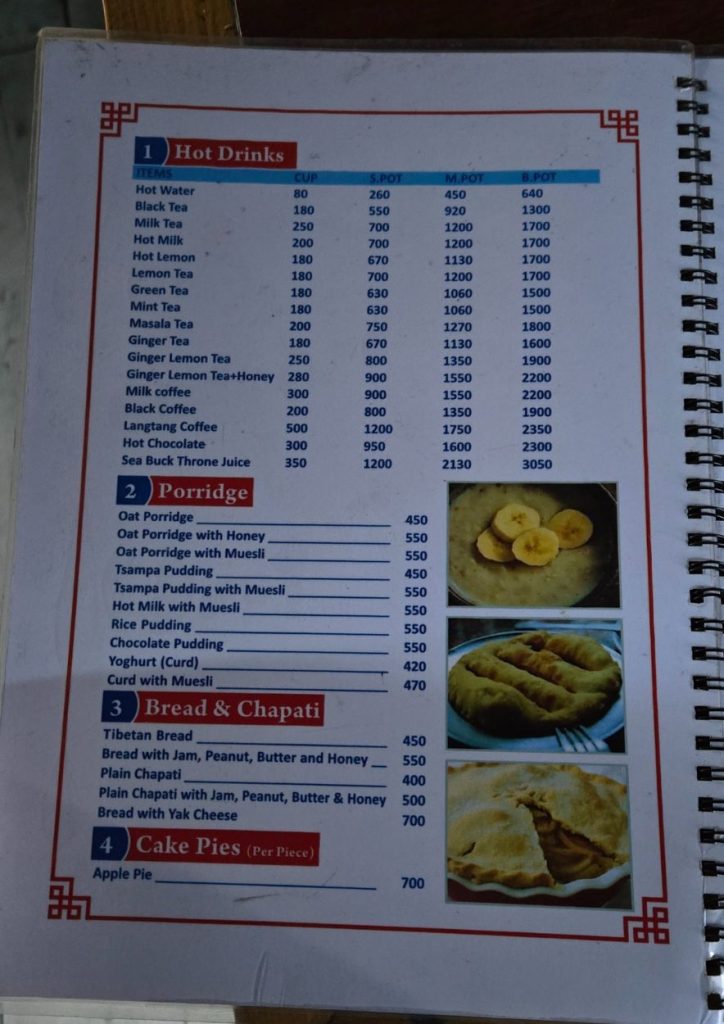
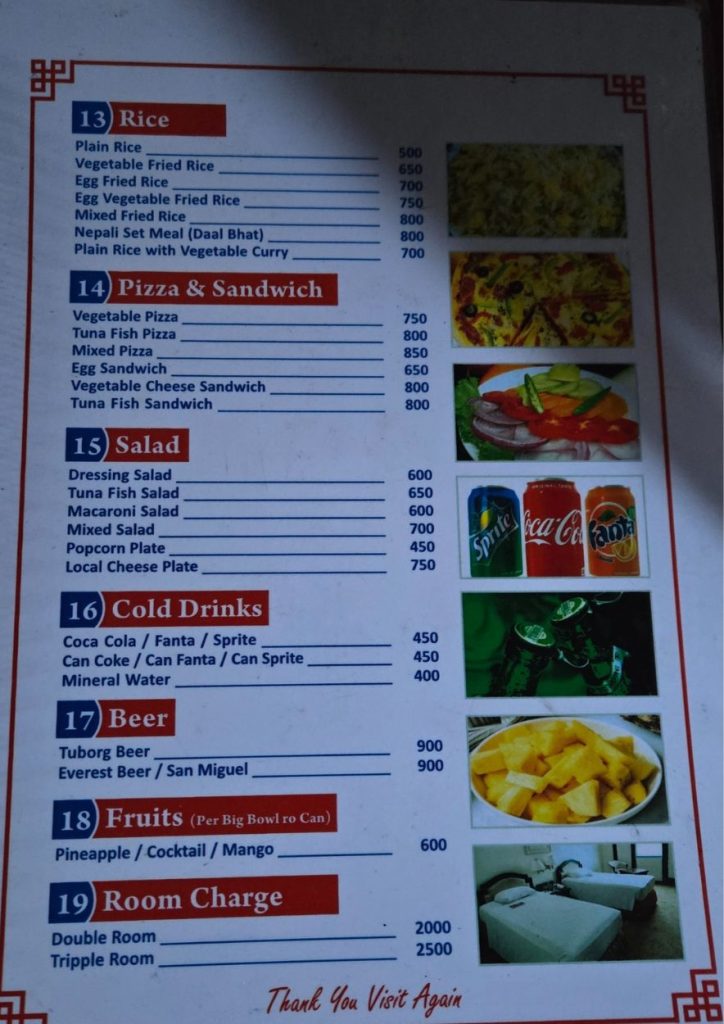
Real Photo of Langtang Valley Trek Menu

Frequently Asked Questions
Is the menu the same in every tea house along the trail?
While not identical, menus across Langtang tea houses are highly standardized. Most lodges use a menu regulated by the local tourism management committee to ensure fair pricing and consistent quality.
What is “Dal Bhat,” and why is it recommended for trekkers?
Dal Bhat is the traditional Nepali meal consisting of steamed rice (Bhat), lentil soup (Dal), vegetable curry (Tarkari), and spicy pickles (Achar).
Why trekkers love it:
- Refills: It is usually “all-you-can-eat” (except for the meat, if ordered).
- Nutrition: It provides a perfect balance of complex carbohydrates and protein needed for long trekking days.
- Freshness: Because it is the staple meal for the staff, the ingredients are almost always the freshest in the kitchen.
Are there Western food options like pasta, pizza, or burgers?
Yes, you will find several Western-inspired dishes. Pasta and noodles (spaghetti, macaroni, and Sherpa stew) are common. While pizzas and burgers may appear on some menus, they are “Himalayan versions”. Pizzas often feature local yak cheese and a hand-rolled crust, while burgers may use local bread and buffalo meat (buff) or veg patties. They are comforting but don’t expect a gourmet Italian or American experience.
Can I find traditional Tibetan dishes like Thukpa or Thenthuk?
Absolutely. Given the Tamang and Tibetan influence in the Langtang region, these dishes are staples.
- Thukpa: A hearty noodle soup with vegetables and sometimes meat.
- Thenthuk: A “pull-style” hand-drawn noodle soup that is slightly thicker and very filling. These are excellent choices for staying hydrated and warm at higher altitudes.
What is Tibetan Bread, and how is it served?
Tibetan Bread is a deep-fried, flat dough that is crunchy on the outside and chewy on the inside. It usually has two distinct slits in the middle. It is served hot with honey, jam, or butter. It is much heavier and more caloric than standard toast.
Are snacks like chocolate bars and Pringles available to buy on the trail?
Yes, most tea houses and small shops along the trail sell “trail treats.” You can easily find:
- Chocolate: Snickers, Mars bars, and Dairy Milk.
- Chips: Pringles and local Nepalese brands.
- Biscuits: Glucose biscuits and digestive cookies.
Note: Prices increase significantly the higher you go because these items are carried up by porters or mules.
Are there bakeries in the Langtang Valley (e.g., in Kyanjin Gompa)?
Yes! Kyanjin Gompa is famous for its high-altitude bakeries. After reaching the final destination of the trek, you can reward yourself with: Freshly baked apple pie, Chocolate croissants, Carrot cake.
Many of these bakeries also serve “real” espresso and latte-style coffee, providing a much-needed luxury at 3,800 meters.
Can the tea houses accommodate a vegan diet?
Yes, the Langtang Valley is vegan-friendly. The staple dish, Dal Bhat, is naturally vegan (rice, lentil soup, and vegetable curry), provided you ask them to omit the ghee (clarified butter). Vegetable Thukpa, fried potatoes, and pasta with tomato sauce are also widely available. However, ensure you specify “no milk, eggs, or butter,” as these are common ingredients in Himalayan cooking.
Are there gluten-free meal options available?
While “gluten-free” isn’t a standard label on trek menus, many traditional dishes are naturally gluten-free. Dal Bhat (rice and lentils) and potatoes (boiled, fried, or mashed) are the safest choice. Avoid Tibetan bread, Chapatis, and noodles, which are wheat-based.
How do I communicate my food allergies to the lodge owners?
The most effective way is to inform your trekking guide beforehand. By communicating your food allergies to us in advance, our guide will take the responsibility of informing the tea house owner and kitchen staff at every stop. This ensures that your meals are prepared safely and specifically to your requirements.
What is “Butter Tea,” and should I try it?
Butter Tea (Su-Chya) is a traditional Himalayan drink made from tea leaves, yak butter, and salt. It is an acquired taste, more like a salty soup than a sweet tea. Should you try it? Yes! It is highly effective for preventing cracked lips in the cold and provides a quick energy boost from the fats.
Is it safe to drink tap or stream water if I use purification tablets?
Generally, yes. Using high-quality purification tablets or a portable filter (like a LifeStraw or Grayl) makes tap or stream water safe to drink. However, you should still avoid drinking directly from streams near villages or yak grazing pastures. For maximum safety, stick to the Safe Drinking Water stations or boiled water provided by lodges.
How much does a liter of boiled water cost at higher altitudes?
Nowadays, trekkers normally do not need to pay extra for boiled water. However, in some situations, you can expect to pay anywhere from 150 to 400 NPR (roughly $1.15 to $3.00 USD) per liter. Bringing a thermos is highly recommended to keep your water warm throughout the night and the following morning.
Are soft drinks like Coke, Fanta, and Sprite available?
Yes, most lodges stock popular soft drinks. Like all items carried up by porters, they become more expensive as you ascend. A bottle of Coke in Kyanjin Gompa can cost three to four times the price in Kathmandu.
Can I buy beer or local alcohol (like Raksi or Chhyang) on the trail?
Yes, you can find bottled beer (like Everest or Gorkha) and local spirits:
- Raksi: A clear, potent distilled millet/rice wine.
- Chhyang: A milky, fermented millet or rice beer. While available, they are best enjoyed on the way down rather than during the ascent.
Is it true that I should avoid alcohol while ascending?
Yes, this is highly recommended. Alcohol dehydrates the body and can mask the symptoms of altitude sickness (AMS), making it harder to tell if you are struggling with the elevation. It also interferes with your sleep and recovery.
How much should I budget per day for food and drinks?
For a comfortable trek, you should budget between USD 15 to USD 20 per day. This typically covers three meals (including a hearty Dal Bhat dinner) and basic hot drinks like tea or coffee. If you plan on buying bottled beer, specialty bakery items, or multiple liters of boiled water, you may want to budget slightly higher.
Do I need to pay for hot water to fill my thermos?
Yes, tea houses charge for hot water because fuel (gas or wood) is scarce and difficult to transport to high altitudes. Prices are usually listed on the menu per cup or per “small/large pot.”
Can I pay for my meals using a credit card or digital wallet?
No, you probably won’t be able to pay for meals using a credit card or digital wallet. In the Langtang Valley, cash is king. You should carry enough Nepalese Rupees (NPR) to cover all your meals, drinks, and tips for the duration of the trek. There are no ATMs beyond Syabrubesi.
Is it safe to eat meat (chicken/buff) at high altitudes in Langtang?
It is advised to avoid meat at high altitudes. Meat is usually carried up from lower elevations by porters or mules in non-refrigerated baskets. By the time it reaches Kyanjin Gompa, it may not be fresh. To avoid food poisoning, stick to vegetarian options like eggs, cheese, and lentils.
What should I eat if I start feeling symptoms of altitude sickness?
If you feel mild symptoms of Acute Mountain Sickness (AMS), focus on:
- Garlic Soup: A famous local remedy believed to help with blood oxygenation.
- Carbohydrates: Plain rice, crackers, or bread to maintain energy.
- Hydration: Drink plenty of warm water and ginger tea.
- Avoid: Heavy proteins, fatty foods, and alcohol, which are harder for the body to digest at altitude.
Is the cheese in the valley made from Yaks or Nak (female yaks)?
Technically, it is made from Nak milk. In the Sherpa and Tamang languages, “Yak” refers only to the male animal, while the female is called a “Nak.” However, it is internationally marketed and locally referred to as Yak Cheese for simplicity. It is rich, nutritious, and a must-try in the valley.
Can I visit the famous Yak Cheese Factory in Kyanjin Gompa?
Yes! The Kyanjin Gompa Cheese Factory (established with Swiss assistance in the 1950s) is a popular stop. You can visit to see the traditional production process and purchase fresh cheese to snack on during your trek or to take back as a souvenir. It is usually open during the trekking seasons (Spring and Autumn).
What are the best foods to eat to maintain energy for steep climbs?
For sustained energy, prioritize complex carbohydrates.
- Dal Bhat: The slow-release energy from rice and lentils is unbeatable.
- Oats/Porridge: Excellent for a slow burn throughout the morning.
- Potatoes: A local staple in Langtang that provides clean energy.
- Energy Bars/Nuts: Great for quick snacks during short breaks.
Do I need to order my dinner and breakfast in advance?
Yes. To keep things efficient, tea houses require you to order your dinner a few hours before eating (usually upon arrival). For breakfast, you should place your order the night before and specify the time you plan to eat. This allows the kitchen to manage the limited stove space and ensure you can start your hike on time.
What time is dinner usually served in the lodges?
Dinner is typically served between 6:00 PM and 8:00 PM. The dining hall is usually the only heated room (via a central wood stove), so most trekkers gather there early to stay warm and socialize before the kitchen closes.
Can I request a packed lunch for long trekking days?
Yes, most lodges can prepare a “packed lunch,” which usually consists of boiled eggs, fried potatoes, bread, or a simple sandwich. Be sure to request this the night before so it is ready when you depart in the morning.
What happens if I arrive late at a lodge? Will they still serve food?
If you arrive after the standard dinner hour, the hosts will usually still prepare a basic meal (like Dal Bhat) for you. However, options may be limited, so it is always best to try and reach your destination before dark.
Are there communal dining tables, or can I eat in my room?
Eating is almost always done at communal tables in the main dining hall. This is the heart of the tea house, where the heater is located. Eating in your room is generally discouraged because it is much colder and the lodges prefer to keep food smells and potential spills out of the sleeping quarters.