Lama Hotel: Interesting History, Geography, and Village
What Trekkers Should Know About Lama Hotel
Lama Hotel is a small trekking settlement inside Langtang National Park in the central Himalayan region of Nepal. The site lies between Syabrubesi and Langtang Village along the lower section of the Langtang Valley trekking route. It consists of a compact cluster of teahouses positioned beside the Langtang Khola, where trekkers stop during the ascent toward higher villages such as Ghodatabela and Kyanjin Gompa.
The settlement developed in the 1980s to support increasing foot traffic on the route. Its structures, seasonal population, and limited facilities reflect its role as a service point rather than a traditional village. Lama Hotel’s location, forested surroundings, and position within the national park define its physical layout and restrict long‑term expansion.
This document outlines the key elements that explain Lama Hotel’s character: its recent history, geographic setting, seasonal settlement pattern, ethnic background of its operators, and its function within the established trekking corridor of the Langtang Valley.
Table of Contents
History of Lama Hotel
Lama Hotel does not possess an ancient or traditional settlement history. Its origin is relatively recent, developing approximately 30–35 years ago during the 1980s. The settlement was created almost entirely to support the rise of trekking tourism within Langtang National Park.
The structures in Lama Hotel were built by residents of Langtang Village, located further up the valley. During trekking seasons, these residents temporarily moved to the Lama Hotel area to operate teahouses. Most returned to Langtang Village during the off‑season.
Because Lama Hotel lies inside Langtang National Park, the buildings fall under government ownership. People operating teahouses do not hold private land ownership. Their involvement is limited to seasonal operation under national park regulations.
Ethnic and Cultural Background
The settlement is associated with communities of Tamang and Lama origin. These groups share cultural links with Tibetan Buddhism, which remains the dominant religion. The spoken languages in the area include Tibetan, Nepali, and Tamang.
Although Lama Hotel is not a traditional village with longstanding cultural institutions, its seasonal residents retain the cultural traditions of Langtang Valley, which has deep Tibetan‑influenced heritage and long-standing mountain livelihoods.
Population and Built Environment
The settlement began as a cluster of teahouses built to provide rest facilities for trekkers navigating the steep forested corridor of the lower Langtang Valley. Its population remains very small, averaging 15 to 20 people, mostly seasonal residents working during peak trekking periods.
Lama Hotel is not a single hotel but a group of multiple teahouses, usually around seven, forming a compact cluster. These structures function exclusively as accommodation and meal points rather than as a community with permanent households.
Geographical Context and Route Development
The settlement’s history is directly shaped by the growth of the Langtang Valley trekking route. As trekking increased in the 1980s and 1990s, Lama Hotel became an essential stopping point because of its strategic midway position on the route between Syabrubesi and Langtang Village.
The area around Lama Hotel features dense forests of bamboo and rhododendron, forming a natural transitional zone between the lower river corridor and the higher alpine settlements. The trail through this forest corridor has been an established trekking path for decades. Its consistent use by trekkers reinforced the necessity of maintaining teahouses in the Lama Hotel area.
Impact of Regional Historical Events
The settlement itself did not exist during earlier historical periods of Langtang Valley, and thus has no pre‑modern archaeological or cultural record. However, the region surrounding it, especially Langtang Village, experienced major changes following the 2015 Nepal earthquake, which triggered a massive avalanche that destroyed Langtang Village entirely.
Because Lama Hotel lies at a lower elevation and outside the direct impact area of the avalanche zone, it did not undergo the same level of destruction. After Langtang Village was rebuilt in subsequent years, Lama Hotel continued to serve its trekking role with minimal historical disruption. The trekking corridor, including the route passing through Lama Hotel, was gradually restored as access improved.
Tourism-Driven Evolution
The settlement’s entire formation and continued existence depend on trekking tourism. Lama Hotel has no road access and can only be reached by foot from Syabrubesi, requiring roughly a full day of walking.
This isolation prevented the development of permanent infrastructure unrelated to trekking. Seasonal teahouses remain the defining features of the site, and facilities such as electricity, hot showers, and food services are provided primarily to meet trekking needs.
Summary of Historical Character
- Time of establishment: 1980s (around 30–35 years ago).
- Purpose: Created specifically to serve Langtang Valley trekkers.
- Founders/Operators: Residents from Langtang Village moving seasonally.
- Cultural identity: Tamang and Lama heritage; Buddhist influence.
- Population: Approximately 15–20 seasonal residents.
- Administrative status: Inside Langtang National Park; buildings government‑owned.
- Role in regional history: Key trekking stop; indirectly affected by post‑earthquake recovery in Langtang region.
Location and Geography of Lama Hotel
Lama Hotel is located inside Langtang National Park in the central Himalayan region of Nepal. The settlement lies north of Kathmandu and south of the Langtang mountain range and the Tibet border, forming part of the lower Langtang Valley trekking corridor.
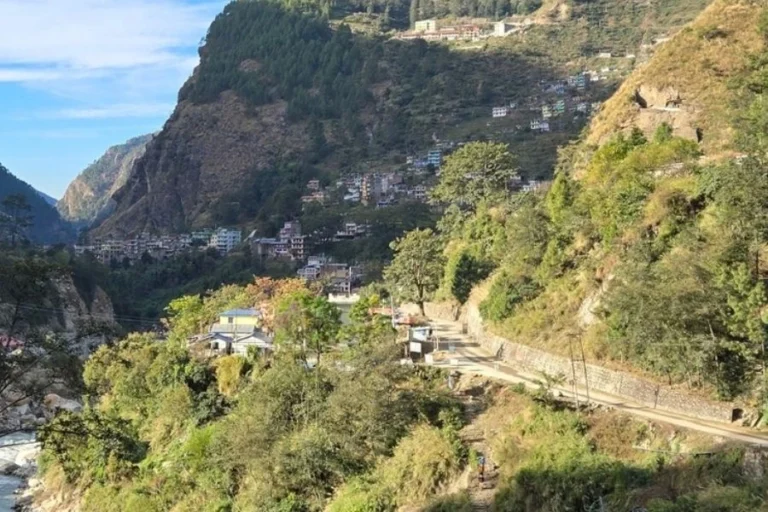
The cluster of teahouses sits directly along the Langtang Khola (Langtang River), which flows through a narrow gorge between dense forested slopes. The river shapes the settlement’s linear layout and defines the valley floor that trekkers follow when approaching higher-altitude villages such as Ghodatabela, Langtang Village, and Kyanjin Gompa.
Lama Hotel stands at an elevation of 2,470 meters (8,136 feet) above sea level. This altitude marks the transition from lower subtropical vegetation to temperate Himalayan forests. The surrounding landscape contains thick bamboo and rhododendron forests, which create a narrow ecological corridor between Syabrubesi and the higher alpine pastures of Langtang Valley.
The settlement is reached only by foot. The closest road ends in Syabrubesi, located a full day’s walk downhill from Lama Hotel. The absence of road access preserves the original forest cover and maintains the narrow trekking path as the primary access route through the valley.
The geographic position of Lama Hotel places it at the base of a steep, forest-shaded canyon. The valley walls rise sharply on both sides, creating a sheltered environment with limited direct sunlight. This terrain produces cool temperatures, high moisture levels, and frequent cloud cover. Trekkers passing the area follow a pathway that runs parallel to the river, crossing small wooden bridges and contouring along the canyon’s slopes.
Lama Hotel’s location also serves as a natural midpoint between Syabrubesi and Langtang Village, allowing it to function as an early-stage rest stop within the larger topographic sequence of the Langtang Valley route. Its consistent placement along the narrow river corridor makes it a geographically fixed landmark in the lower valley.
Houses and Village Structure in Lama Hotel
Lama Hotel contains around seven teahouses, forming a small linear cluster along the Langtang Khola. These structures are positioned close to the trekking route, allowing trekkers to access accommodation without entering side paths or dispersed settlements. The buildings operate seasonally and remain active mainly during peak trekking months.
The structures are simple wooden and stone buildings designed for basic lodging. Rooms follow a minimal layout with shared toilets, shared dining spaces, and small sleeping quarters. The upper floors often contain shared Western‑style toilets, while the lower floors may include squat toilets accessible via short exterior walkways.
There are no permanent agricultural fields, workshops, or community institutions. The cluster functions exclusively as a service point along the trekking route rather than as an independent, self‑sustaining village.
The buildings sit directly beside the forested canyon and the river corridor, following a narrow linear arrangement shaped by limited flat terrain. This terrain restricts expansion, resulting in a compact settlement pattern with each teahouse positioned within close walking distance of the next. Trekkers encounter the structures sequentially as they ascend the valley.
Trekking Routes Connected to Lama Hotel: Langtang and Gosaikunda
Lama Hotel lies directly on the primary Langtang Valley trekking route, which begins in Syabrubesi and continues toward Langtang Village and Kyanjin Gompa. The same corridor also links to the extended Langtang–Gosaikunda trekking route, which connects the Langtang Valley to the high‑altitude lakes of Gosaikunda and ends near Sundarijal in the Kathmandu Valley.
Trekkers following the traditional Langtang–Gosaikunda north‑to‑south route start from Syabrubesi, pass through Lama Hotel, continue to Langtang Village and Kyanjin Gompa, and then cross the Lauribina La Pass before reaching the Gosaikunda Lakes. The trail then descends through Chisapani and concludes at Sundarijal. This route provides gradual altitude gain and spans the full sequence of rivers, forests, high passes, and glacial lake zones. The best time to do Langtang and Gosaikunda trekking is on October 5 to December 20 and March to May.
Conclusion
Lama Hotel functions as a small, service‑based settlement shaped entirely by the trekking route of the Langtang Valley. Its recent origin in the 1980s, its seasonal population, and its cluster of simple teahouses reflect a structure created for practical needs rather than long-term habitation. Its location inside Langtang National Park, its forested river corridor, and its position between Syabrubesi and Langtang Village define both its limitations and its importance.
The site continues to serve as a stable midpoint for trekkers moving toward the higher Himalayan settlements. Its operators maintain cultural links to the larger Langtang region, while the geography around the canyon and the Langtang Khola restricts expansion and preserves its compact layout. Together, these elements reinforce Lama Hotel’s role as a functional stop within a protected mountain landscape, shaped by terrain, tourism, and the wider cultural history of the Langtang Valley.